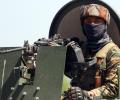
The real heroes of Operation Sindoor were not the armed forces or political leadership, but the ordinary citizens of India who refused to fall into the trap of communal provocation, asserts Colonel Anil A Athale (retd).
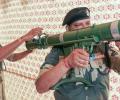
The Border Security Force (BSF) is raising a maiden 'drone squadron' for deployment along the India-Pakistan border. The squadron will comprise reconnaissance, surveillance and attack drones and specially-trained personnel.

Tharoor said that though India's case might not be at the top of the agenda for the US media, India can get its message across easily.
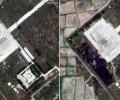
The attacks against the Pakistani air force have taken them at least five years back and caused great damage to them and their Chinese and Turkish inventory of weapons.

Union Home Minister Amit Shah said on Sunday that indigenously developed BrahMos missiles destroyed Pakistani air bases while its air defence system, borrowed from China, remained unused, during Operation Sindoor, which exposed its lies on terrorism to the world.
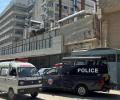
A young Indian man was arrested in Pakistan after illegally crossing the border to meet a Facebook friend he wanted to marry. However, the woman told police she was not interested in marrying him. The man, Badal Babu, was arrested in the Mandi Bahauddin district of Pakistan's Punjab province on December 28. He had crossed the border to meet his Facebook friend, Sana Rani. Rani, in her statement to police, said she had been friends with Babu for the past two-and-a-half years but was not interested in marrying him. Babu's family has appealed to the Indian government to intervene for his release.

Shahzad was apprehended on Sunday by the STF Moradabad unit following inputs about his alleged involvement in cross-border smuggling and espionage activities for the ISI.
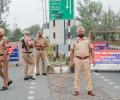
In a significant breakthrough, the Malerkotla Police apprehended two individuals for alleged involvement in espionage activities linked to a Pakistani official posted at the High Commission in New Delhi, said Punjab Director General of Police (DGP) on Sunday.

'The Pakistan establishment keeps him well protected.'

The Chinese see no need to fight directly. They have an able and willing proxy in Pakistan, points out Shekhar Gupta.

The Border Security Force (BSF) remains on high alert along the International Border (IB) and has not let its guard down, BSF Inspector General, Jammu Frontier, Shashank Anand said on Tuesday. Operation Sindoor, aimed at preventing infiltration attempts, continues as Pakistan cannot be trusted, he added. Anand highlighted the BSF's robust response after the April 22 Pahalgam terror attack, including destroying multiple terror launch pads and thwarting infiltration attempts.
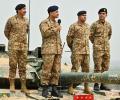
United States President Donald Trump will host Pakistan Army chief Asim Munir for lunch at the White House on Wednesday.

The National Investigation Agency (NIA) on Saturday conducted a massive search operation at 15 locations in eight states across the country in a Pakistan-linked espionage case.
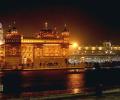
The Army on Monday showcased a demonstration of how Indian Air Defence systems, including AKASH missile system, L-70 Air Defence Guns, saved the Golden Temple in Amritsar and cities of Punjab from Pakistani missile and drone attacks.
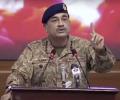
Asim Munir and his brand of short-sighted army officers give no inkling of paying heed, changing course or learning lessons from the past, observes Rana Banerji, who headed the Pakistan desk at RA&W.

'An important consideration was that we should always be at the top of the escalation ladder. When we reach a military objective, we should try and put a stop to it'

The blame must be shared by the investigating agencies, the government of the day and the nation at large, points out Colonel Anil A Athale (retd).

The Indian intelligence brass may have snared a key Pakistani spy and Jadhav's arrest is Pakistan's way of getting even with India, says Rajeev Sharma.
The officials said that intelligence agencies had been alerted about the possibility of a terror attack, but the inputs were utilised at another place, some 90 kilometres away from the site where the attack took place, resulting in a key security lapse.
'If there is a military standoff eyeball to eyeball on the western border, the Chinese could create problems by making movements in the north, in our northeast, which could involve us tying down some forces there so that could stretch our military actions.'
'Pakistan cannot sustain a war with India for more than four days. They are in such dire straits. At best they can sustain war for one week.'
'Neither are Baloch insurgents capable of breaking up Pakistan, nor has Pakistan learned any lessons from the 1971 debacle that led to the country's dismemberment.'

The statement came hours after Prime Minister Narendra Modi on Tuesday told the top defence brass that the armed forces have "complete operational freedom" to decide on the mode, targets and timing of India's response to the Pahalgam terror attack, government sources said.

'But that was not our aim. Our objective was already achieved.'
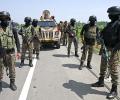
India needs to be technologically and militarily prepared to defend itself from both Pakistan and China, alerts Ramesh Menon.

'However, we must implement a tit-for-tat approach -- reciprocating their conduct with precision.' 'If they demonstrate respect, we respond accordingly. If they adopt hostile positions, we mirror that hostility with equal intensity.'
Following the deadly Pahalgam attack, Michael Rubin, a former Pentagon official and senior fellow at the American Enterprise Institute, issued a strong statement and said that 'it is now the duty of India to do to Pakistan and to Pakistan's Inter-Services Intelligence (ISI) what Israel did to Hamas', calling for decisive action against Pakistan's intelligence agency for its alleged role in supporting terrorism.

The closed-door luncheon meeting came amid escalating tensions between Israel and Iran with Trump exploring Washington's possible involvement.

Days after the Pahalgam terror attack, Jammu and Kashmir authorities have deported 59 Pakistani nationals, including the mother of Shaurya Chakra awardee Constable Mudasir Ahmad Sheikh. The Pakistani nationals were living in the valley for decades and were transported to Punjab for repatriation. However, the mother of the deceased soldier was later allowed to stay back. The deportation comes after the Indian government announced a slew of measures against Pakistan in the wake of the Pahalgam attack, including the suspension of the Indus Waters Treaty and the downgrading of diplomatic relations.

Congress leader Priyanka Gandhi Vadra launched a scathing attack on the government regarding the Pahalgam terror attack, questioning intelligence failures and demanding accountability.

Haryana Police on Thursday said it arrested an Army personnel for allegedly passing secret information to Pakistani intelligence agency ISI.

A senior government official confirmed that after a meeting with other stakeholders, the decision has been taken and airlines and airport authorities have been informed about it.
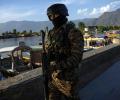
The 'mediation' by the United States from behind the scene on the diplomatic track appears to be once again working, which calls on both Delhi and Islamabad to show restraint and pull back from a military confrontation, notes Ambassador M K Bhadrakumar.

'The background for the Saudi-Pakistan agreement is the fact that the regional security order has collapsed due to the Israeli attack on Doha.' 'The Americans have largely abandoned their security guarantee for West Asia and the region has no choice but to look at alternatives.'

'What the Americans want is to destabilise Iran. For destabilising Iran, you need access. 'One access is through Iraq. The other access is through Pakistan.'

Shakur Khan was detained on Wednesday night by an intelligence department team who were acting on security-related inputs.

'The lesson Beijing would have learned is that there is, cost-benefit wise, no better option than to keep the Pakistan military supplied with its most advanced armaments, certain that in hostilities with India these would be used for maximum effect.'

It is considered one of the most crucial appointments within the Indian Army, according to an official statement from the Ministry of Defence.

'Had Haji Pir and/or Skardu been taken, the message would have gone out not just to General Asim Munir and his cohort in the Pakistan army but to the Pakistani people that every terrorist incident in India would lead to substantial loss of territory in PoK.'

'If they aim to remain aligned with the public sentiment, as any democratic government should, then they must respond. Why else would the prime minister have cut short his visit to Saudi Arabia? And why would he have instructed the home minister himself to travel to Srinagar to assess the situation firsthand? This suggests that something is indeed being planned. I am quite certain of that, although the exact form it will take remains to be seen.'
